
By Greg Riley
An MTD Trail Flite, a broken collarbone, a big yellow Labrador, and a little slice of Beaumont in 1974.
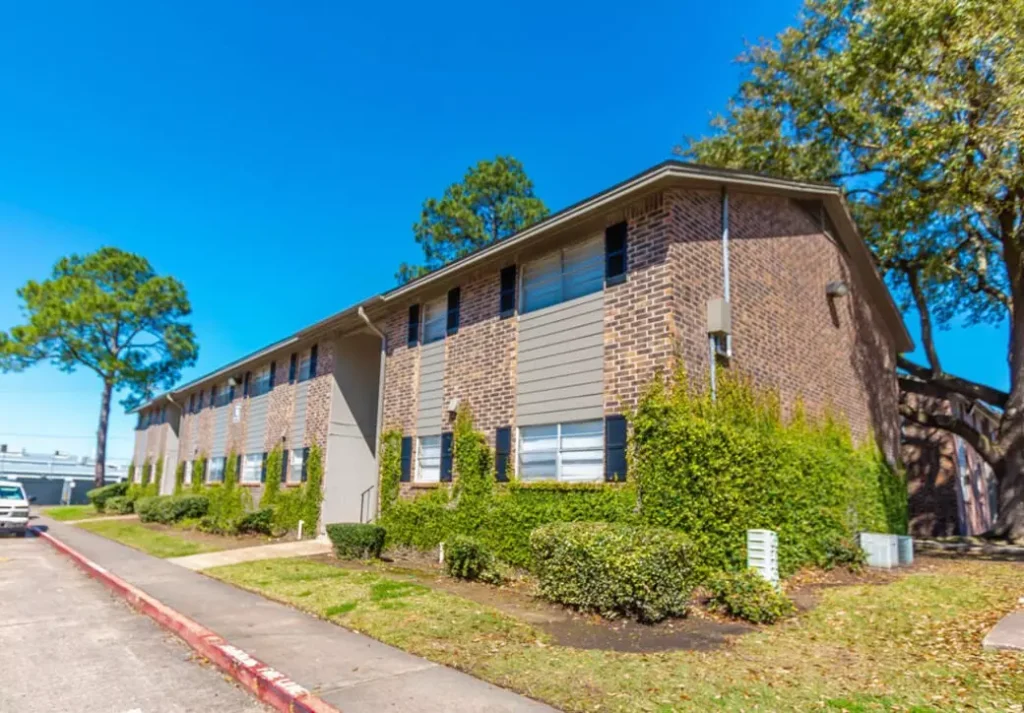
In the spring of 1974, I was twelve years old and living with my family at French Road Apartments in Beaumont, Texas. My father had died the previous May, and it had been a difficult year for our family.
That Easter, my younger sister Shannon and I received a brand-new MTD Trail Flite minibike, courtesy of our mother, Annie Ruth, better known as Miss Annie.
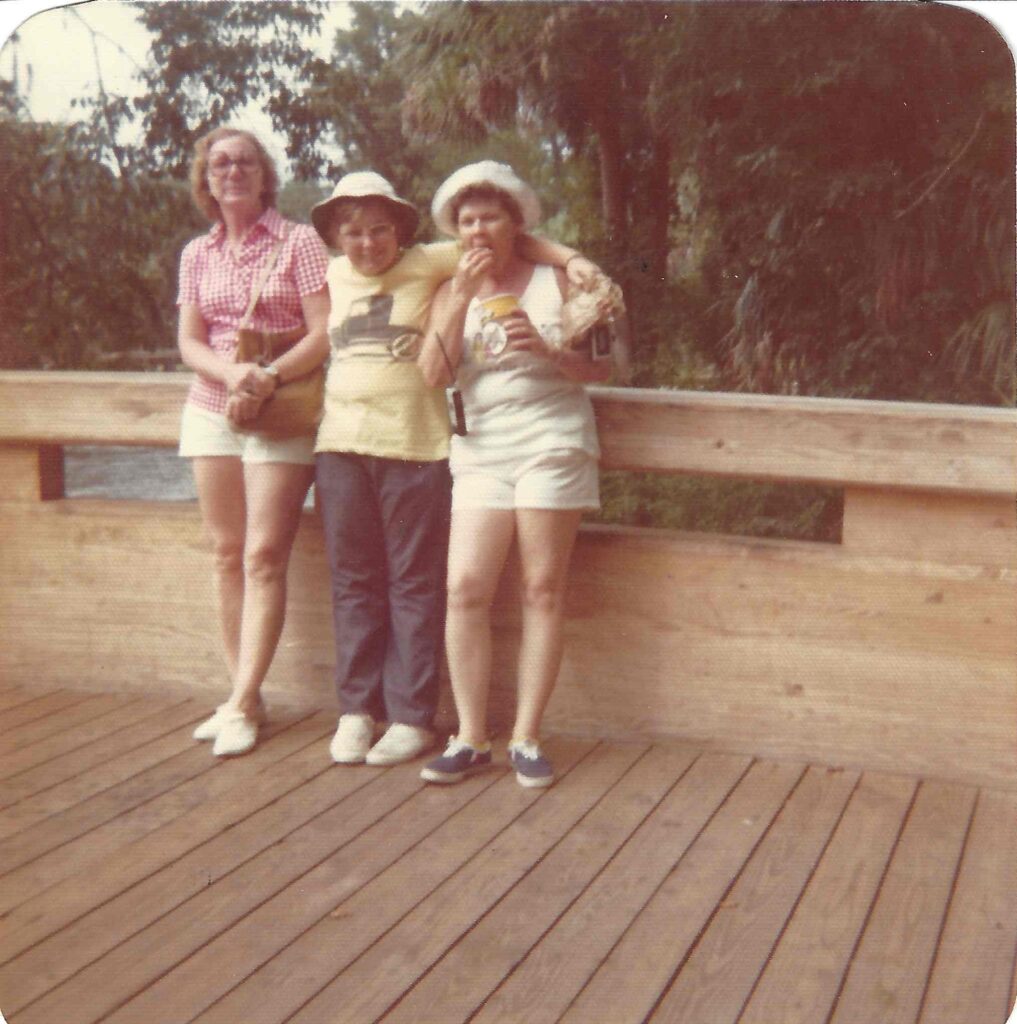
She had taken us to White’s Supply in Beaumont’s Village Shopping Center and casually pointed out the minibike.
I was absolutely smitten with that little machine.
Remember Winthrop in The Music Man, when his new cornet arrives on the Wells Fargo Wagon? He excitedly describes it as the most “scrumptious solid gold thing” he’d ever seen.
Well, that was pretty much how I felt about the MTD Trail Flite sitting on the showroom floor at White’s Auto Supply.
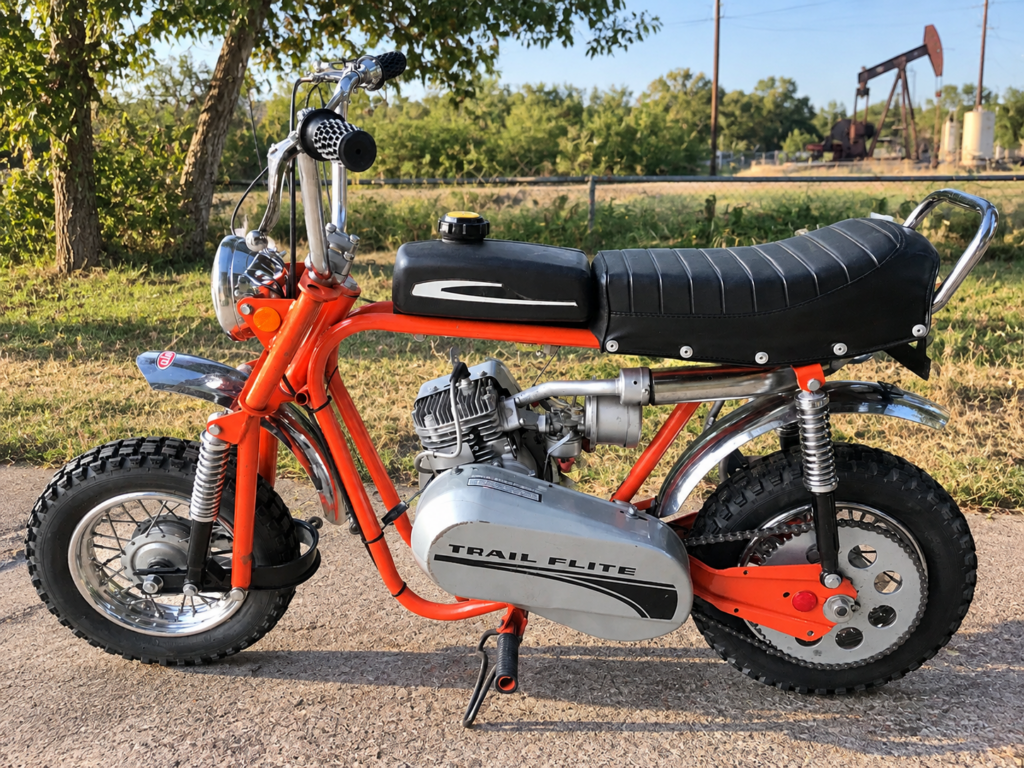
It wasn’t solid gold, of course. It was a beautiful metallic orange, with chrome fenders, wire wheels, front and rear suspension, and a four-horsepower Tecumseh engine.
To a twelve-year-old boy in 1974, it might as well have been a Rolls-Royce.
Miss Annie explained that we couldn’t possibly afford anything that expensive.
And that, I figured, was that.
What we didn’t know was that she’d already arranged for my brother-in-law Glen to smuggle the thing home in his old Chevy pickup.
Miss Annie bought the minibike on what folks used to call “time.” White’s offered installment credit, and I believe the Trail Flite cost somewhere around $295. If memory serves, she made payments on it for the next couple of years.
That was a substantial amount of money in 1974, especially for a family that had lost its father less than a year earlier. In today’s money, $295 would be roughly $1,900, give or take. Not exactly pocket change.
But somehow she made it happen.
Ironically, a few years later, White’s retail space would be occupied by Gibson’s Discount Center, where I was working by 1977.
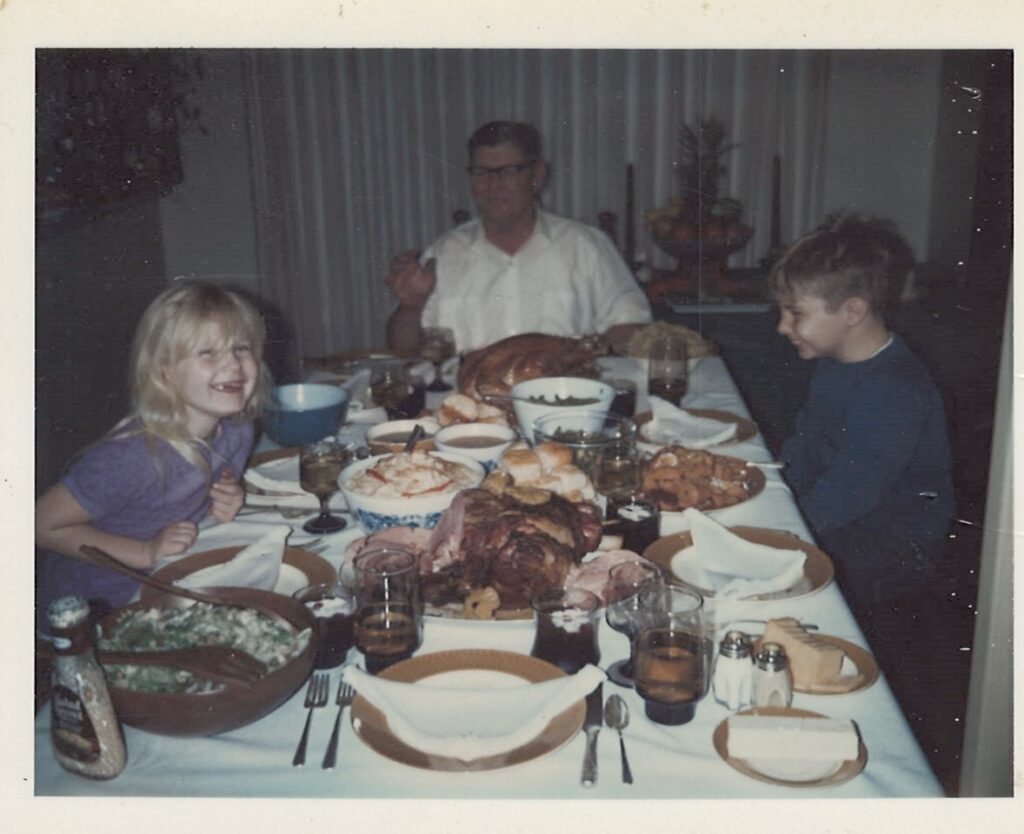
The minibike was supposed to belong to both Shannon and me. In practice, I more or less took possession of it. I don’t recall any formal negotiations or transfer of ownership. It just gradually became my minibike.
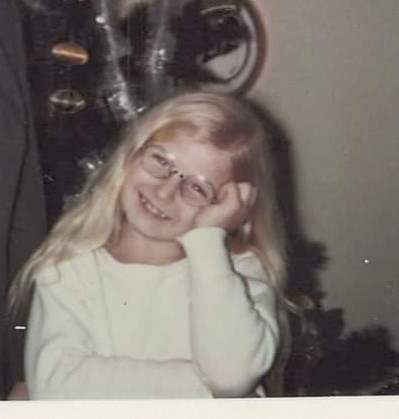
Shannon was always the social butterfly of the family. I was more likely to be the fellow quietly working the lights and sound for the drama club.
We had different interests.
And mine had a four-horsepower Tecumseh engine.
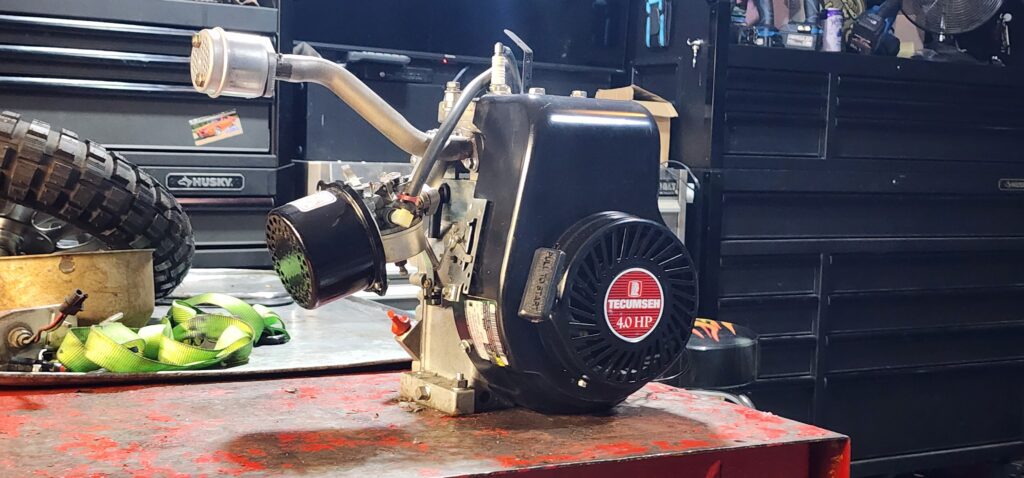
Jerri Ann Takes a Ride
My older sister Jerri Ann was an adult by then, but barely, at twenty-two. She was visiting with her husband Glen, and they had brought along Sam, their big yellow Labrador retriever.
Sam was a wonderful dog, although he had some definite negative opinions about motorized transportation.
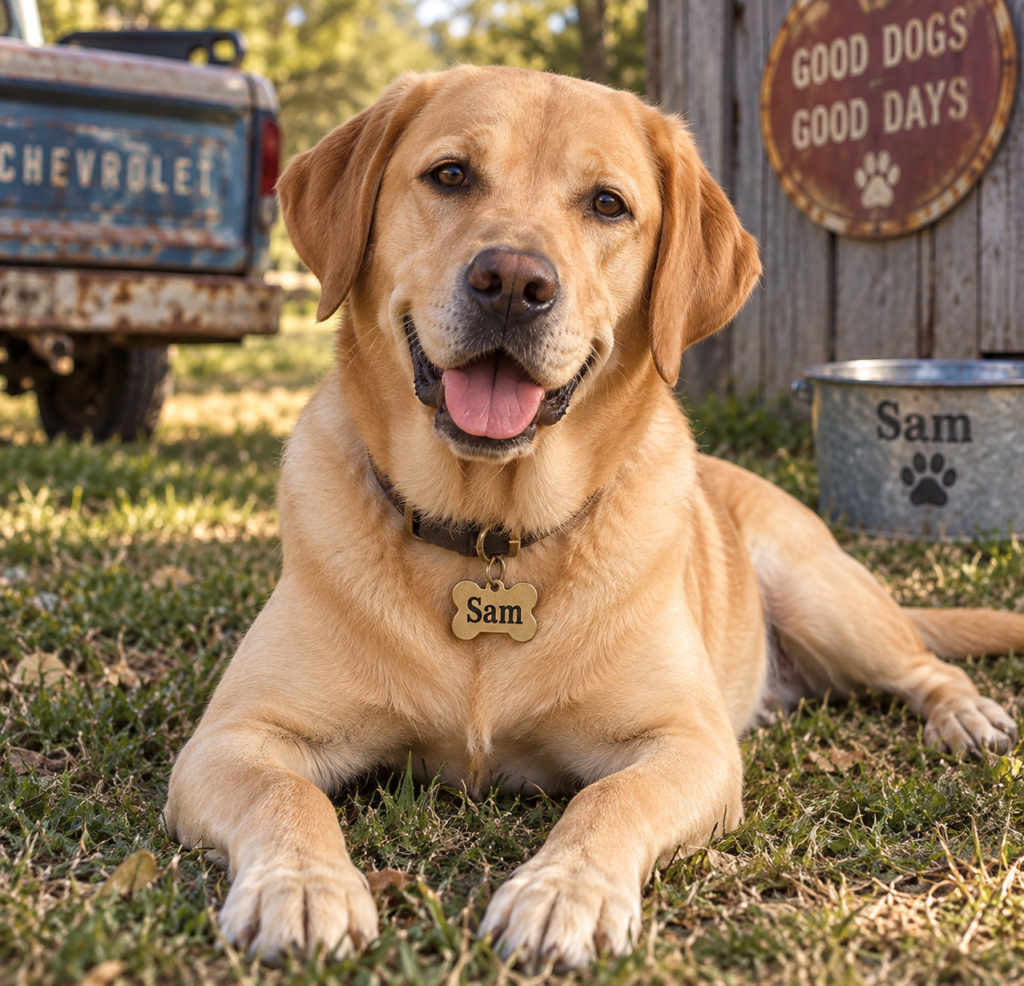
Jerri Ann decided she’d take the new minibike for a spin.
Now, unlike many of the little minibikes sold during that period, the MTD had both front and rear brakes. That was actually one of its better features, although it didn’t work out particularly well for Jerri Ann.
She inadvertently grabbed the front brake a little too enthusiastically.
Over the handlebars she went.
And broke her collarbone.
On the very first day we owned the thing.
Miss Annie was understandably less than enthusiastic about our new gift. As I recall, she was ready to get rid of the damned thing that same day.
Fortunately, cooler heads and some serious begging prevailed. Or perhaps she simply had other things to worry about, including our big sister with a broken collarbone.
Whatever the reason, the Trail Flite stayed.
And for the next couple of years, it became one of the most important possessions in my twelve-year-old world.
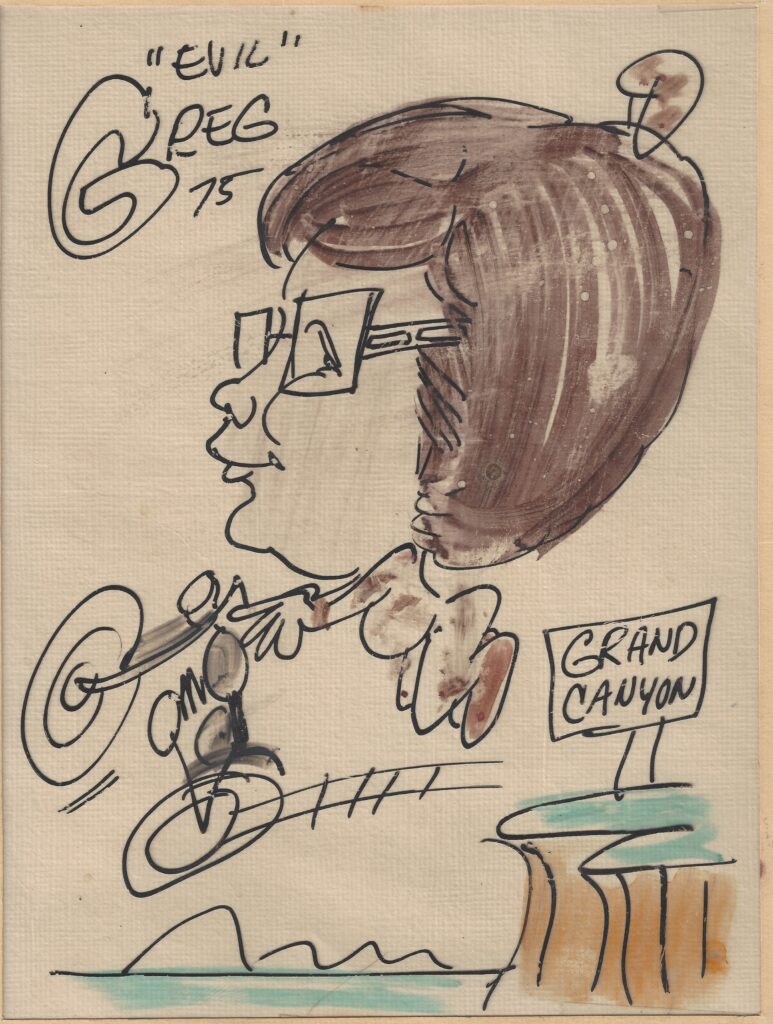
“Evil Greg,” a caricature drawn at the South Texas State Fair in 1975. The artist even included my MTD Trail Flite.
French Road Apartments and Our Own Little World
French Road Apartments was located behind David Taylor Buick in Beaumont, near the French Trading Post Museum.
Adjacent to the apartments was a department-store property that had originally housed Bellas Hess. The store closed and remained vacant for a considerable period before eventually reopening as Gemco. Many years later, the property became Beaumont’s first Walmart Supercenter.
Living in an apartment complex wasn’t exactly my idea of paradise. We didn’t have a big yard, a garage, or much room to do the things I liked doing. French Road Apartments would eventually develop a rather unsavory reputation, although I don’t recall it being particularly bad when we lived there.
It was also a revolving door of families and children. Some residents, including our family and Jack Dennis’s parents, stayed for years. Others seemed to arrive, unpack, stay six months, and disappear again. There was almost always somebody new to meet, although keeping track of everybody could be a challenge.
What we lacked in living space, however, we more than made up for in places to explore.
The spring and summer of 1974 had a pretty memorable soundtrack, too. Ray Stevens was all over the radio with his novelty hit The Streak, which reached No. 1 that May.
Considering that Jerri Ann had already gone flying over the handlebars of our brand-new minibike, perhaps it was an appropriate song for the occasion.
And yes, I can still hear it fifty-some years later.
The vacant Bellas Hess parking lot and surrounding open ground were just about perfect for a couple of kids with minibikes.
Behind the property, an oil-field road disappeared into the brush. It led to several production sites, complete with pump jacks, barrels, large oil-storage tanks, and assorted equipment. Some of it appeared abandoned, or at least wasn’t seeing much activity.
We explored it all.
Looking back, I’m not entirely sure the oil companies would have appreciated a couple of twelve-year-olds using their lease roads as a private motocross course.
But nobody seemed particularly concerned at the time.
And the Trail Flite was made for that sort of thing.
Eventually, another kid moved into the apartments with a Yamaha Enduro motorcycle. As I recall, this was around 1975, and the bike was a 175cc model.
Compared with our little four-horsepower MTDs, that Yamaha was serious machinery. It could run circles around all the neighborhood minibikes while making that incredible one-cylinder two-stroke music.
We were moving up in the world. Or at least the neighborhood was.
Jack Dennis and the Identical Minibike
My childhood friend Jack Dennis received an identical MTD Trail Flite in the spring of 1974, also purchased from White’s Auto Supply. I don’t recall whether his was an Easter gift.
Jack and I rode together constantly. We traveled the same roads, crossed the same fields, encountered the same mud, and generally subjected our machines to the same conditions.
Yet somehow our minibikes never looked as though they belonged to the same species.
I kept mine in pristine condition.
Jack’s was always dirty, raggedy, and seemingly leaking oil from somewhere.
We could spend an entire afternoon riding together, park the bikes side by side, and mine would look as though it had just come out of the showroom.
Jack’s looked as though he’d ridden it all the way through a Louisiana swamp.
I never understood that.
Some people are simply harder on machinery than others.
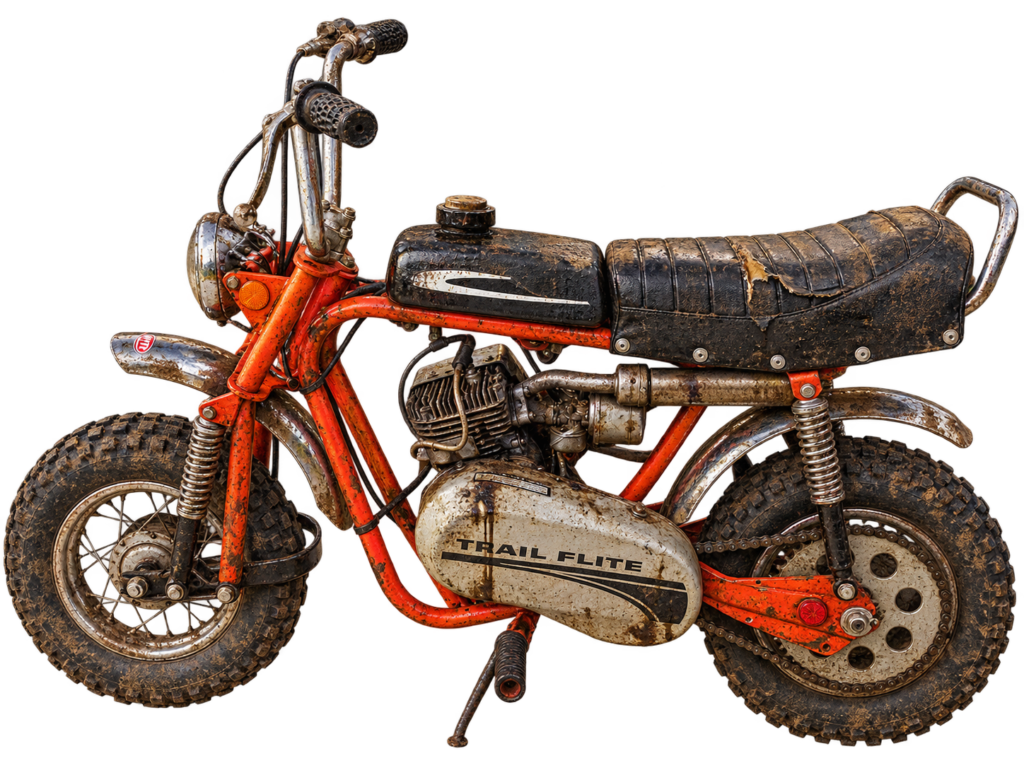
Even at twelve, I was apparently developing the habits that would eventually lead to a lifetime of collecting and restoring cars, motorcycles, and other things with engines.
Shannon, meanwhile, probably wondered whatever happened to her half of the minibike.
Sam the Labrador
Sam deserves a little recognition in this story.
He was a big yellow Labrador who took a particular interest in our minibike activities.
Whenever the Trail Flite was running, Sam would bark excitedly and act as though chasing it was the most natural thing in the world.
He wasn’t allowed to. Glen would tie him to the bumper of his ancient Chevy pickup, which had a homemade wooden camper.
That was probably wise. Between Jerri Ann’s broken collarbone and Sam’s enthusiasm for pursuit, our family had already accumulated enough minibike-related excitement.
Still, I suspect Sam would have been perfectly happy to spend his afternoons chasing Jack and me around the Bellas Hess parking lot.
Golden E Rides
That same spring and summer, the vacant department-store parking lot became home to a small carnival called Golden E Rides.
The name was inspired by Disneyland’s famous E-ticket attractions.
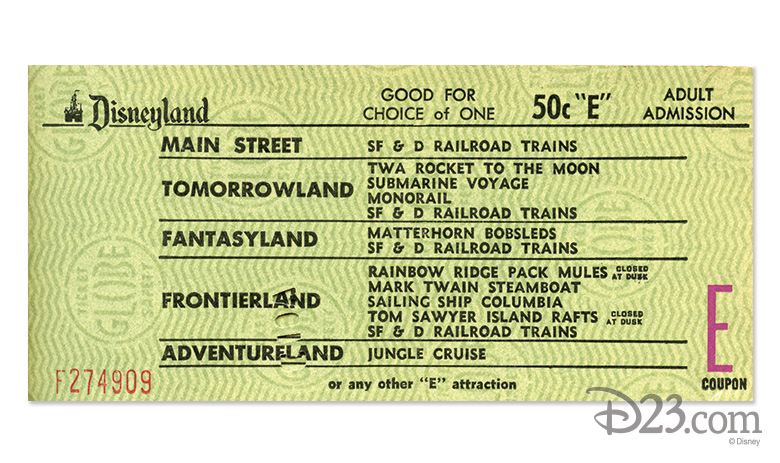
The family operating it consisted of Roy, his daughter Rosie, and his son Roy Jr. Their surname was pronounced something like Eisnaugle, although I’m no longer certain of the spelling.
They lived in an old converted bread truck.
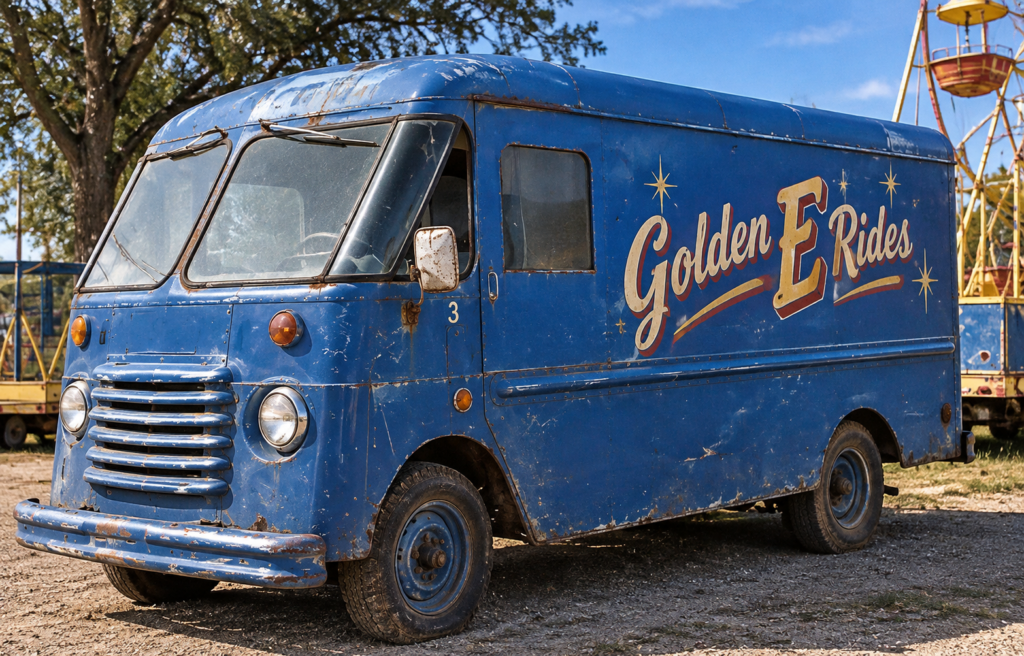
Roy Sr. was gradually assembling a traveling carnival by acquiring used rides and equipment, repairing and restoring them, and adding them to his growing operation.
At first, they had only a few rides, including a tiny Ferris wheel and an old-fashioned swing ride.
To me, it was fascinating.
Here was a fellow taking worn-out mechanical equipment, fixing it up, and putting it back to work. I was already interested in anything with an engine or moving parts, so a little carnival being assembled practically in our backyard was quite an attraction.
When they acquired a cotton candy machine, Shannon and I were their first customers.
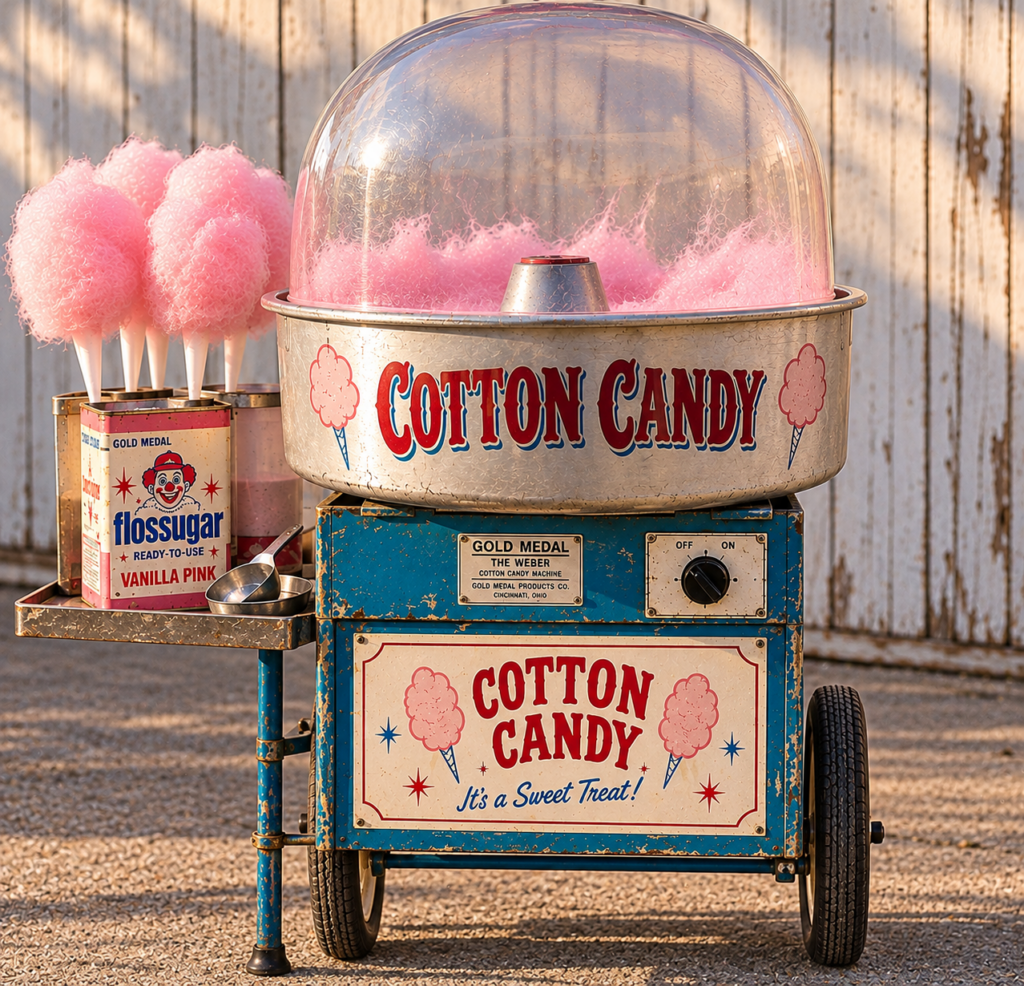
Later, I worked out an arrangement with Rosie. I gave her rides on the minibike, and she gave me free cotton candy.
Not a bad business arrangement for a twelve-year-old.
Imagine the scene: an empty department store, a small carnival slowly taking shape in the parking lot, two boys riding minibikes, a big Labrador barking at them, and an oil-field road disappearing into the brush behind everything.
It was a pretty wonderful place to be a kid.
What Made the MTD Trail Flite Different?
By the early 1970s, everybody and his brother seemed to be selling minibikes.
Some were pretty crude affairs: a little four-stroke engine, a centrifugal clutch, small wheels, rudimentary brakes, and just enough steel tubing to hold everything together.
MTD went considerably further.
MTD, originally Modern Tool and Die, was a major American manufacturer better known for bicycles, lawn equipment, and other consumer products.
Around 1970, the company entered the minibike business with a range of machines sold under the Trail Flite name.
The better Trail Flites were surprisingly sophisticated.
They had real front and rear suspension, wire-spoke wheels, drum brakes at both ends, and a variable-ratio torque converter rather than the simple centrifugal clutch found on many inexpensive minibikes.
The leading-link front suspension was especially distinctive. The rear suspension used a swingarm and twin shocks, and the Tecumseh engine was mounted at an angle within the frame.
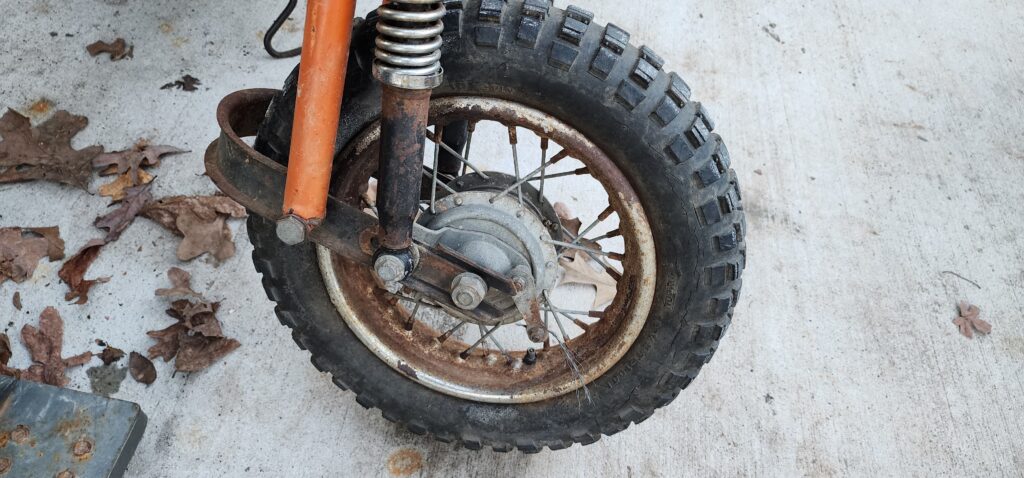
Some models even had headlights and taillights.
These weren’t quite motorcycles, but they were getting awfully close.
They offered a credible alternative to some of the smaller Japanese trail bikes from Honda and Yamaha, although by about 1976 MTD appears to have left the minibike business.
Rupp gets much of the attention among American minibike collectors today, and deservedly so. Honda’s Mini Trail became an icon. But MTD built a remarkably capable little machine that somehow never achieved the same recognition.
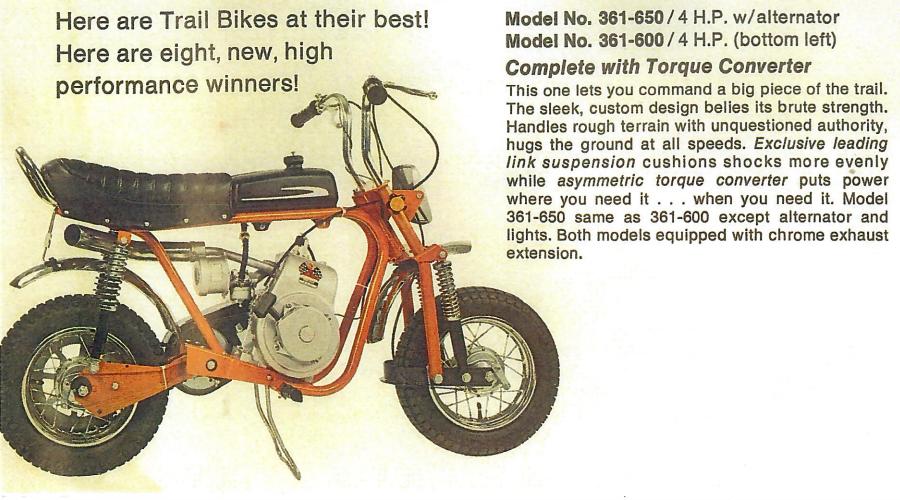
Period MTD literature showing the full-suspension Trail Flite. These machines were considerably more sophisticated than many of their contemporaries.
MTD’s 1971 catalog listed eight models, ranging from basic 2½-horsepower machines to the more elaborate four-horsepower 361-600 and 361-650.
Over the next few years, the company introduced different handlebars, larger front wheels, more powerful engines, and a variety of running changes.
Unfortunately, MTD’s model-number system was not always particularly straightforward.
Even today, identifying a particular model and year can require a little detective work.
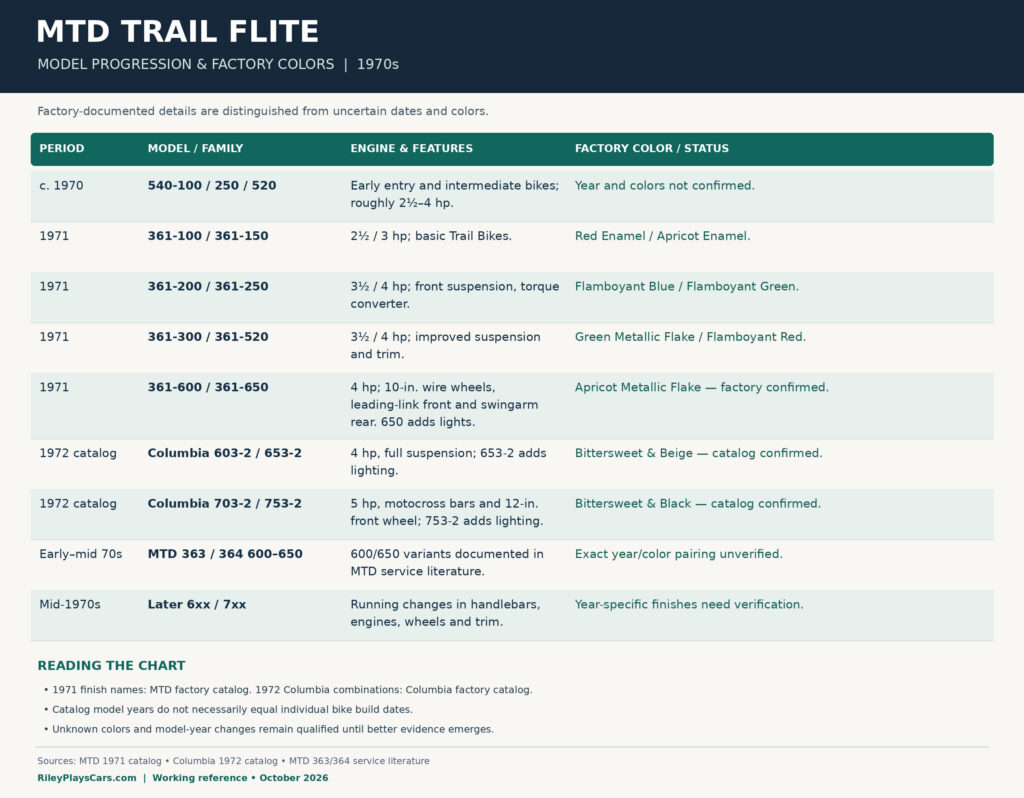
I’ve been researching these machines using original factory sales literature, service manuals, and surviving examples. Some information available online is excellent, while other details are contradictory or simply repeated without supporting evidence.
As best I can determine, there is still quite a bit about MTD’s minibike production that deserves further investigation.
We’re preparing a separate, more detailed MTD Trail Flite historical reference here on RileyPlaysCars for readers interested in model identification, specifications, original colors, and production changes.
Fifty Years Later
Eventually, my original Trail Flite disappeared from my life.
I don’t remember exactly when I last rode it, but I certainly never forgot it. I was about fifteen years old when it got sold, and by then I’d moved on to being obsessed with cars…and girls.
Over the years, I owned and worked on hundreds of cars and other mechanical contraptions. Every so often, though, I’d think about that little MTD and wonder whether I could find another one.
Truth be told, after so many years I could picture practically every mechanical part of my minibike in my mind’s eye, but couldn’t remember the manufacturer’s name to save my life.
For years I looked, particularly for a 1974 like the bike Shannon and I received that Easter.
I now own four MTD Trail Flites.
My 1973 is a largely original survivor, and I intend to keep it that way.
The 1974 is the one I particularly wanted. It isn’t my childhood minibike, but it’s the closest thing I’ve found to bringing that machine back into my garage. My intention is to restore it to pristine original condition.
I also have two 1975 models, the later, higher-horsepower machines with larger front forks and front wheels.
One will be restored to original condition.
The other has a modern 6½-horsepower Predator engine and will become my primary rider. I intend to modify it considerably.
After all, there isn’t much point in owning four minibikes if you can’t have some fun with at least one of them.
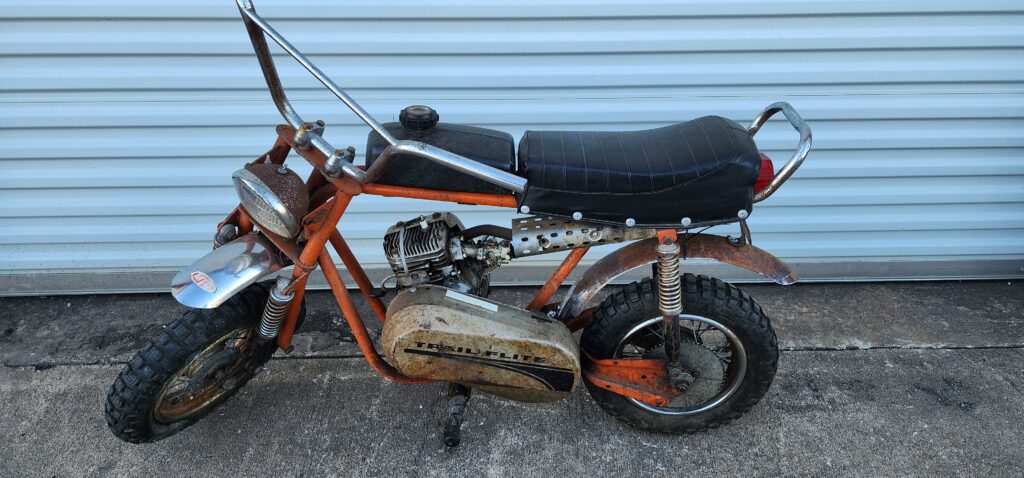
One of the surviving MTD Trail Flites in my collection. The bikes have become both a restoration project and a continuing research adventure.
I’ve also accumulated original MTD literature and photographed the bikes extensively as I’ve worked on them.
Some of the research has already corrected assumptions about model numbers, factory equipment, and even original paint colors.
For instance, MTD’s own 1971 literature describes the finish on its 361-600 and 361-650 as Apricot Metallic Flake. That’s considerably more specific than simply calling the bikes yellow or orange.
The tiny reflective particles in surviving paint have become a research project of their own.
It’s the kind of detail that probably wouldn’t have interested twelve-year-old Greg in 1974.
Sixty-four-year-old Greg, however, finds it fascinating.
Full Circle
I still have that caricature from the South Texas State Fair in 1975.
There I am, a kid with his minibike, completely unaware that more than fifty years later I’d be collecting MTD Trail Flites and researching their history.
The 1974 sitting in my garage isn’t the machine Jerri Ann sailed over the handlebars on. It isn’t the one Jack and I rode behind Bellas Hess, or the one Sam wanted so badly to chase.
And it isn’t the minibike Shannon and I received during a difficult spring after losing our father.
That particular Trail Flite is long gone, and so is my friend Jack.
I hope Rosie and Roy are still out there somewhere, occasionally remembering that first minibike summer.
But the one I have now is close enough to take me back there.
Sometimes you’re restoring a machine.
Sometimes you’re restoring a connection.
And this time, I intend to keep it.
Have an MTD Trail Flite or original factory literature? We’re working to document the history of these interesting American minibikes. If you have original brochures, model information, photographs, or other factual material, we’d be delighted to hear from you.


