
The $500 Super Sport That Got Away
By Gregory Riley
A Long-Form Automotive Memoir
Author’s Note: This is the first in a series of long-form stories about my auto-maniacal adventures. The goal is a great story you can enjoy in about 15 minutes. Stay tuned. There are plenty more where this one came from!
An Unlikely Choice
In the winter and spring of 1982, I was working at Gibson’s Discount Center in the Village Shopping Center in Beaumont, Texas. It was a satellite location of the much larger Gibson’s store on Eleventh Street, which also housed the buying offices, accounting department, and other administrative functions.
I’d been offered an opportunity for a promotion that would take me to the Eleventh Street store. There was just one problem. I needed reliable transportation.
Up to that point, I’d owned a succession of what we might politely call hoopties. These were old, half-junk automobiles, invariably afflicted with some major problem. There was the ’69 Firebird 400 with the weak transmission, then the 1971 Cutlass 4-speed with the wrecked front end, etc. None was what I would consider reliable transportation. I’d also been sharing a car with my mother from time to time, but our increasingly different schedules had made that arrangement impractical.
I needed a car of my own, preferably one that would actually start every morning and get me across town.
Of course, being a young man in my early twenties, I wasn’t particularly interested in something sensible. I wanted a Camaro, a Trans Am, a Datsun 240Z, or something equally sporty and impractical. Preferably something I couldn’t afford.
A friend mentioned that his neighbor in Bevil Oaks, Texas, had a Monte Carlo for sale.
A Monte Carlo? No thanks.
A few days later, he offered another detail.
It had bucket seats.
Well, that was better, but I still wasn’t particularly interested.
Then he mentioned that it had a center console.
Now we were getting somewhere.
Finally, a few days later, he uttered the magic words.
SS 454.
Suddenly, I couldn’t wait to see that Monte Carlo.
I’d been reading about Chevrolet’s Super Sport models, and the Monte Carlo SS 454 fascinated me. Only 3,823 had been produced in 1970, followed by another 1,919 in 1971 before Chevrolet discontinued the package. I never thought I’d see one in the wild, and in the years since, I seldom have.
I thought of it as The Amazing Ghost.
Here was one of Chevrolet’s most powerful automobiles, hiding in plain sight beneath the conservative styling of a personal luxury coupe.
It was the ultimate gentleman’s sleeper.
Unlike the Chevelle SS, Camaro Z28, or other performance cars of the era, the Monte Carlo didn’t advertise its capabilities with racing stripes, hood scoops, or flashy wheels. Its SS 454 identification was tucked discreetly into the lower body moldings.
The asking price was $500, which was a substantial amount of money for me at the time. Nevertheless, I arranged to go look at it.
The Super Sport Nobody Wanted
The Monte Carlo had an interesting history before I ever laid eyes on it.
It had originally been sold by McRoberts Chevrolet in Houston, Texas, and still wore the dealership’s emblem on the trunk lid.
The reason it was sitting abandoned in Bevil Oaks apparently involved a street race a couple of years earlier.
The owner’s son had arranged a race against another friend of mine who owned a brand-new 1980 Chevrolet Camaro Z28 with a four-speed transmission.
During that race, the Monte Carlo, as we later learned, broke a valve spring.
Big-block Chevrolets had something of a reputation for broken valve springs, but the symptoms could be alarming. The engine developed a dead miss and began popping back through the carburetor.
The owner and his son apparently concluded that the 454 had suffered a catastrophic internal failure.
Rather than repair it, they parked the car.
And there it sat, gradually sinking into the soft Southeast Texas ground, until I came along roughly two years later.
My high school friend Wayne accompanied me to look at the car, as did my friend Don, who was a few years older and worked as a master mechanic at the local Dodge dealership.
We’d been warned that the Monte Carlo was sitting on four flat tires. Don happened to have four wheels and tires left over from his 1969 L78 Camaro. The tires still had plenty of tread, although they were probably as hard as rocks.
We loaded the battery, some portable air tanks, gasoline in a squirt bottle, and an assortment of tools into Don’s 1970 El Camino and headed for Bevil Oaks.
A Diamond in the Rough
The Monte Carlo was not an encouraging sight.
It was sitting on four flat tires, sunk into the ground nearly to its frame rails. Pine straw and mildew covered the body, and the whole car looked as though nature was slowly reclaiming it.
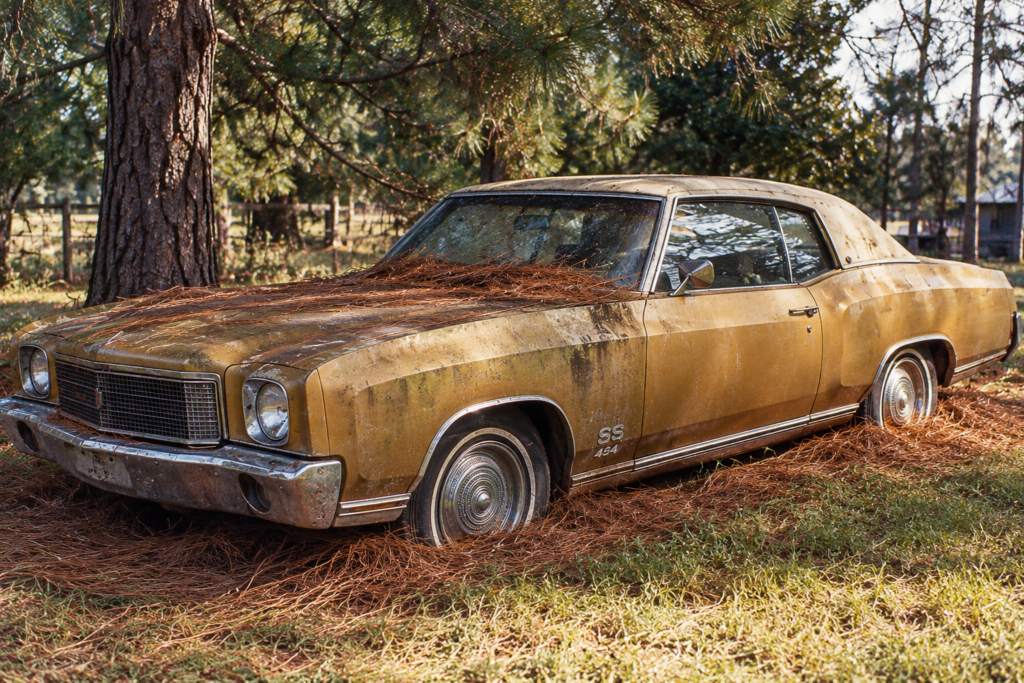
Opening the door released that unmistakable odor of mildew peculiar to automobiles that have spent too much time sitting in the humid climate of Southeast Texas.
There was black mildew on portions of the interior, and for a moment I had some serious doubts.
This was a long way from the Camaro or Trans Am I’d imagined myself driving.
Then I opened the hood.
There sat Chevrolet’s enormous 454-cubic-inch big-block V8.
I had to have it.
We installed the battery, inflated the tires as best we could, and began trying to start the engine. After several attempts, the big-block finally came to life.
It sounded terrible.
There was a pronounced dead miss, accompanied by popping back through the Rochester Quadrajet carburetor. The engine sounded as though something was seriously wrong internally.
The owner believed the engine was blown.
Frankly, it was difficult to argue with him.
But by then I’d made up my mind. I was buying the car.
Getting it out of its resting place proved to be another adventure.
We’d managed to inflate the tires enough to raise the car slightly, but it was still firmly embedded in the ruts. After several attempts to move it, we suddenly noticed something rather alarming.
The pine straw beneath the engine had caught fire.
Apparently, the hot exhaust manifolds and head pipes had ignited the accumulated debris.
We began throwing water underneath the car, eventually retrieving a garden hose from the house. We managed to knock down most of the flames, but the pine straw continued to smolder.
I climbed into Monte Monte (which Wayne named on the spot) and began rocking it back and forth between Drive and Reverse.
After several attempts, the car suddenly popped out of its ruts like a cork from a bottle.
Unfortunately, removing the car also exposed the smoldering pine straw to a fresh supply of oxygen.
The little fire promptly became a minor conflagration of pine straw.
After another round with the garden hose, we finally extinguished the flames.
Our $500 Monte Carlo was free.
We installed the old Camaro wheels and tires and set off for Don’s house in Beaumont, roughly fifteen miles away.
It was not a pleasant drive.
The 454 was missing terribly, the tires had flat spots, and the entire automobile looked like something that should have been headed to the salvage yard rather than back onto the highway. I have terrible allergies and the smell of mold and mildew nearly made me pass out.
Nevertheless, it made the trip.
The Miracle Cure
We pulled into Don’s driveway and left the engine running.
Don walked over and listened.
He grinned.
“Take the air cleaner off.”
I removed the air cleaner, and Don revved the engine a couple of times.
He was almost certain that the engine had a broken valve spring.
I immediately began worrying about removing a cylinder head. As far as I knew, that was the only way to replace a valve spring.
Don had other ideas.
He disappeared into the garage and returned with a rather Rube Goldberg-looking contraption fashioned from part of a compression tester.
The device screwed into the spark plug hole and allowed us to pressurize the cylinder with compressed air. The air pressure held the valves against their seats while we removed the rocker arm and valve spring.
No cylinder-head removal required.
Don had an assortment of Chevrolet valve springs. We selected a suitable replacement, installed it, fitted a fresh valve-cover gasket, and put everything back together.
The entire operation probably took less than an hour.
As I recall, we even found time to spray the engine with Gunk cleaner and wash away some of the accumulated grime.
Then we started the engine.
The difference was astonishing.
The 454 idled smoothly. The dead miss was gone. So was the popping through the carburetor.
The supposedly ruined engine was running perfectly.
Within about two hours of purchasing the Monte Carlo, I had transformed a $500 automobile with a supposedly blown engine into a perfectly running SS 454.
Naturally, there was only one thing left to do.
I backed out of Don’s driveway, shifted into Drive, and floored the accelerator.
Initially, the engine stumbled with a tremendous hesitation.
Then the 454 came ferociously alive.
Both rear tires erupted into a cloud of smoke unlike anything I’d ever experienced.
It didn’t merely spin the tires. It practically annihilated them. Later I learned I could put the rear tires up in smoke at will. The challenge was launching without “wasting the skinnies” (another Wayne-ism).
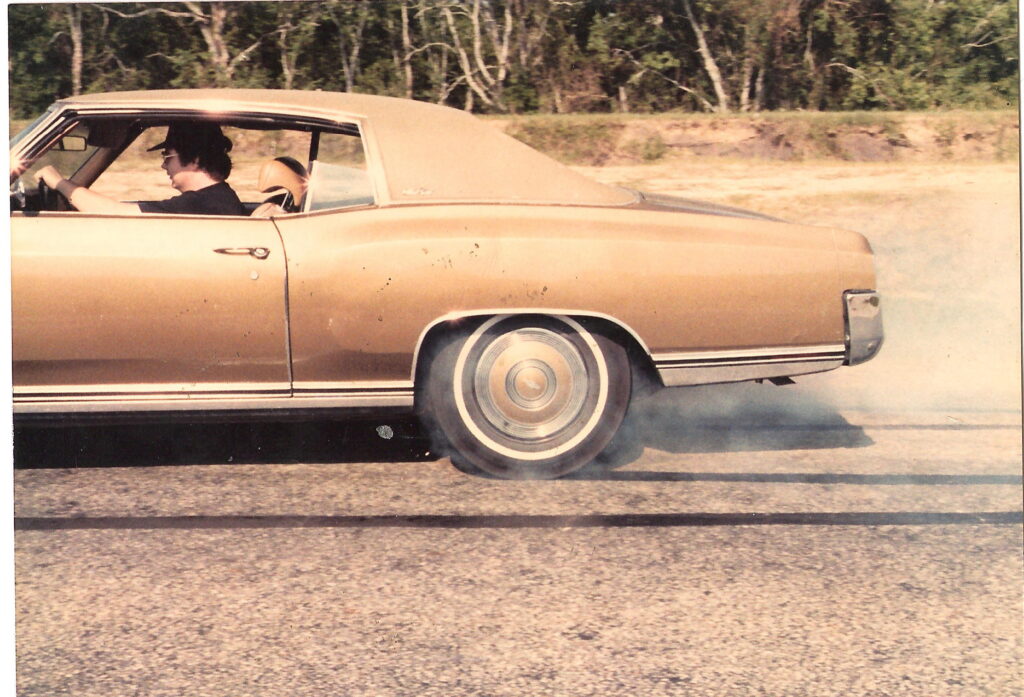
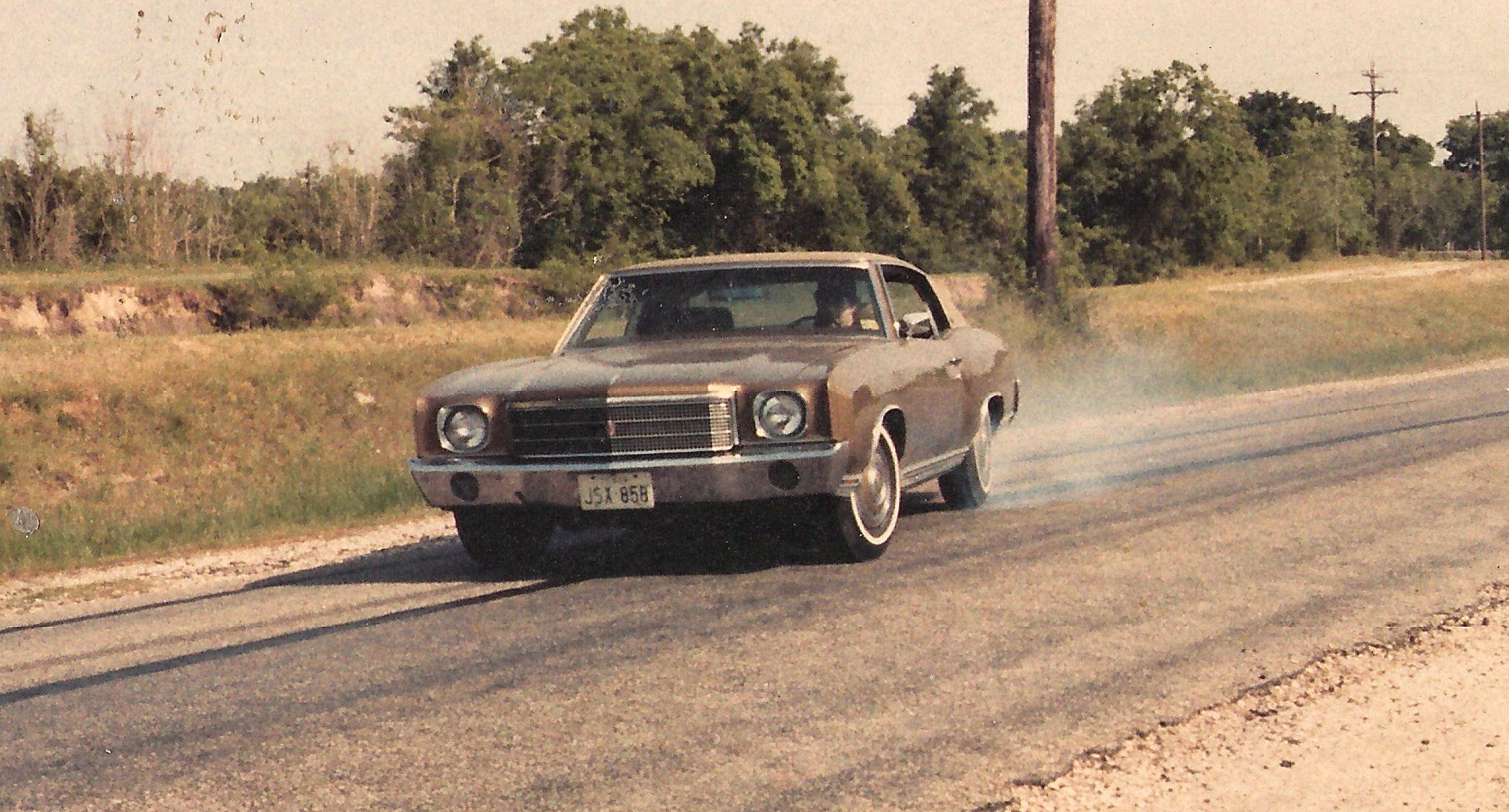
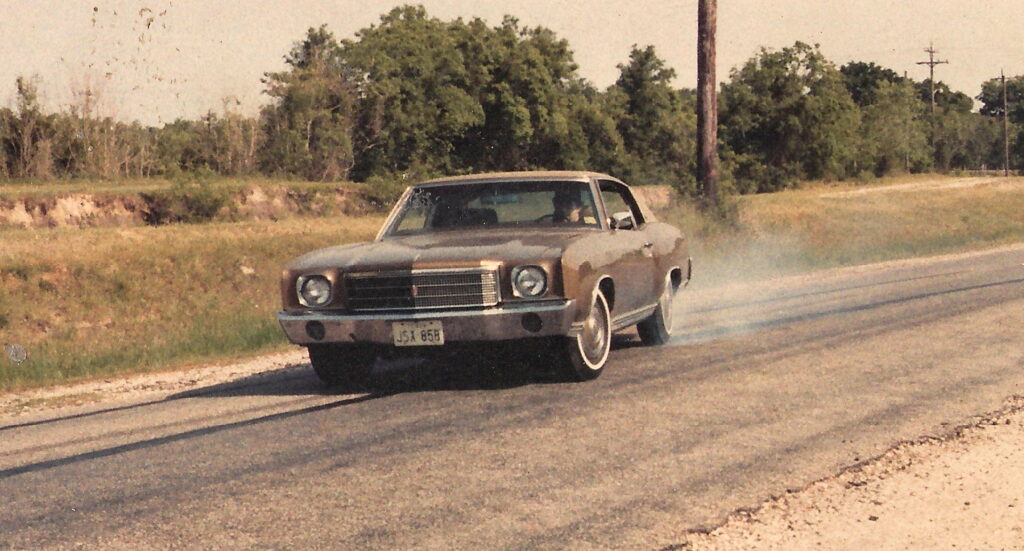
A little tire smoke near Dishman Road in Beaumont, Texas, circa 1982.
AI-assisted smoke animation of an original 1982 photograph from the Gregory Riley Collection. The automobile and original photographic details have been preserved.
I had driven some reasonably quick cars before, but nothing had prepared me for the torque of that enormous Chevrolet big-block.
My $500 luxury coupe was a monster.
From Junkyard Refugee to Luxury Muscle Car
After a couple of enthusiastic trips around the block, we brought the Monte Carlo back and began making plans to put it into proper operating condition.
We performed a complete tune-up, replacing the points, condenser, distributor cap, rotor, spark plugs, and ignition wires. We replaced the other valve-cover gasket, flushed the radiator, changed the ATF and filter and rear-end lube and attended to several additional maintenance items.
Then I began cleaning.
I washed the car thoroughly, inside and out. Don taught me how to use his power buffer, and I went to work on the gold paint.
The results were remarkable.
Underneath the mildew and accumulated dirt was a very nice car.
The paint wasn’t flawless, but it polished up beautifully. The saddle-colored deluxe interior was in excellent condition beneath the grime. I shampooed the carpeting and cleaned away most of the mildew.
The contrasting light-colored vinyl roof complemented the gold paint, and the factory wheel covers gave the car a decidedly conservative appearance.
I took it to Pfau Tire in Beaumont and purchased an inexpensive set of belted tires. As I recall, the entire set cost approximately $100, mounted and balanced.
By the time I finished, the Monte Carlo looked like an entirely different car.
It was a genuine diamond in the rough.
And what a sleeper.
With its vinyl roof, full wheel covers, and understated gold paint, it looked more like something a friend’s grandmother might drive to church than one of Chevrolet’s rarest muscle cars.
That was part of the fun.
Chevrolet’s Luxury Muscle Car
The 1970 Monte Carlo SS 454 was a rather unusual automobile, even by the standards of the muscle-car era.
Chevrolet introduced the Monte Carlo for 1970 as its entry into the growing personal luxury market. It was intended to compete with cars like the Pontiac Grand Prix, combining distinctive styling, comfort, and a long hood with the mechanical components of Chevrolet’s intermediate-size automobiles.
The SS 454 took that concept considerably further.
Under the hood was Chevrolet’s LS5 454-cubic-inch V8, factory-rated at 360 gross horsepower and an astonishing 500 foot-pounds of torque. It was backed by the Turbo Hydra-Matic 400 automatic transmission, one of General Motors’ strongest and most durable automatics.
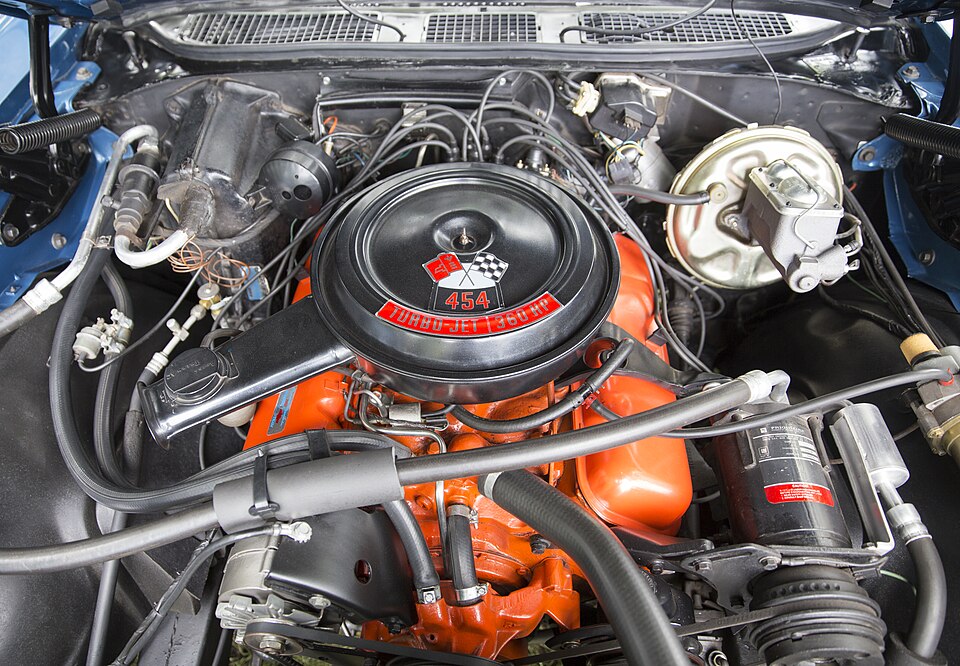
The SS package also included an unusual automatic rear-leveling suspension system, which used a vacuum-operated compressor and air shocks to maintain the car’s ride height.
We checked the rear axle and discovered that Monte Monte had Positraction and a surprisingly tall 2.56:1 gear ratio. Other ratios were available, but the 2.56 was the economy-oriented choice.
Economy, of course, was a relative term.
Driven hard, the Monte Carlo could easily return fuel mileage in the single digits. I’m talking six miles per gallon.
I used to joke that I worked for two years just to keep gasoline in that car. An evening of cruising could require two fill-ups of its seemingly bottomless 20-gallon tank.
I’ve never run out of gasoline so many times in any other automobile.
Only 3,823 Monte Carlo SS 454s were produced in 1970, followed by another 1,919 in 1971 before Chevrolet discontinued the package.
Looking back, I sometimes wonder whether Chevrolet was simply ahead of its time.
In 1983, the company revived the Monte Carlo SS name on a smaller, NASCAR-inspired coupe powered by a 305-cubic-inch V8. Then, in 1994, Chevrolet introduced the Impala SS, combining V8 performance, comfort, and understated styling in a full-size sedan.
Different automobiles for different eras, but variations on a familiar theme.
Both developed enthusiastic followings. Meanwhile, the original 1970–1971 Monte Carlo SS 454 remained something of an unknown. I’ve encountered knowledgeable muscle-car enthusiasts who were barely aware Chevrolet ever built one.
Perhaps Chevrolet had the right idea but hadn’t figured out how to market it. Or perhaps buyers simply weren’t ready for a luxury automobile with the heart of a muscle car.
Whatever the reason, the original SS 454 had arrived more than a decade before its successors.
And that’s precisely what made Monte Monte so much fun.
The Ultimate Sleeper
One of the things that surprised me most was how well the Monte Carlo suited my personality.
I’d always liked high-performance automobiles, but I also appreciated comfort, quietness, and refinement.
The Monte Carlo offered all of those things, especially considering I was all of 20 years old.
It was a magnificent highway cruiser, with a comfortable interior, excellent road manners, and enough torque to make passing other cars almost effortless.
In many respects, the Monte Carlo seemed more like a small Cadillac or a Buick Riviera than a conventional Chevrolet.
The exhaust system had suffered from the car’s long stay in the pine straw. I eventually had new pipes installed, but I couldn’t afford a complete factory-style exhaust system.
Instead, I had turbo mufflers fitted, and the pipes ended in turn-downs ahead of the rear axle at the old Guarantee Muffler on 11th Street.
That arrangement gave the big-block a wonderfully throaty exhaust note.
The car remained quiet and refined during ordinary driving, but opening the throttle revealed an entirely different personality.
And the performance was extraordinary for such a large, luxurious automobile.
I remember quarter-mile performance in approximately the fifteen-second range. Put it in Drive, floor it, and hang on. She’d cross the traps at the 4,500-rpm redline, near the top of second gear, at about 95 mph. Never once got into third in the quarter mile. Monte Monte would have made a great bracket racer due to being absolutely consistent…provided I’d launch without a cloud of tire smoke.
On one occasion, I documented a top speed of about 137 mph. This wasn’t merely a speedometer reading. I had a witness riding in the car, while another person timed our passage between two fixed points to calculate the speed. Yes, there were witnesses and co-conspirators documenting the entire episode.
Looking back, attempting that kind of speed on inexpensive belted tires was probably one of the more foolish things I did with the car.
Braking was another concern.
The Monte Carlo carried considerable weight over its front wheels, and repeated high-speed stops could overwhelm the brakes.
That almost 140 mph top end run required an aggressive shut-down due to traffic. The brakes faded so badly that the pedal went nearly to the floor. Smoke was pouring from all four corners, and the car showed very little interest in slowing down.
That was an experience I would prefer not to repeat. Put another way, lots of go and not enough whoa.
A Few Lessons in Horsepower
The Monte Carlo’s performance was especially entertaining because nobody expected much from it.
With its gold paint, light-colored vinyl roof, full wheel covers, and whitewall tires, it looked like a perfectly respectable luxury coupe.
It certainly didn’t look like a car that belonged in the same conversation as a Trans Am or Mustang GT.
That made the occasional performance encounter particularly satisfying.
I remember an outing involving a big-block Pontiac Trans Am. The Trans Am had two giant four-barrel carburetors sticking through the hood on a tunnel-ram intake. It looked like a legitimate street racer.
The Monte Carlo had a vinyl roof and hubcaps.
I pulled into a parking lot full of cars and kids and parked Monte Monte right next to the Trans Am, amidst a few snickers.
The owner started his car and revved it several times. It bogged badly.
I challenged him to a street race for $50.
The entire entourage went to nearby Delaware Drive. The edge of the concrete bridge was the beginning of the quarter-mile, and the second no-parking signs marked the finish line.
We lined up, the starter’s hand went down, and I holeshot that Trans Am like it was parked.
After the race, the Trans Am guy said the Monte Carlo was some sort of ringer.
I simply pointed to the SS 454 badges at the bottom of the fender that he had missed.
I also remember encounters involving several then-new Mustang GTs, cars whose drivers had little reason to suspect that the big gold Monte Carlo was anything special.
Those ’82 GTs had only 157 net horsepower and 240 lb-ft of torque. They delivered quarter-mile times of about 16 seconds, roughly a full second slower than Monte Monte.
Of course, horsepower ratings had changed considerably since 1970, with the industry switching from gross to net measurements. But the difference in real-world performance was unmistakable.
Those episodes were part of the fun of owning the SS 454. I didn’t have to advertise what was under the hood. The car’s performance could speak for itself.
It was also a reminder of how much automotive performance had changed during the 1970s. The Monte Carlo came from the final years of the original big-block muscle-car era, before tightening emissions standards, rising insurance premiums, and fuel-economy concerns changed the American performance automobile.
By 1982, a 500-foot-pound luxury coupe was an unusual sight.
Especially one wearing full wheel covers.
An Encounter With the Widowmaker
One of my more memorable encounters involved a Porsche 911 Turbo.
In the early 1980s, Jerry Allen Volkswagen-Porsche in Beaumont had a beautiful, triple-black 911 Turbo sitting in its showroom. It was the legendary Porsche 930, the turbocharged 911 with the enormous rear spoiler that enthusiasts called the whale tail.
The 930 had acquired a rather sinister nickname: the Widowmaker.
These cars were notoriously demanding to drive, partly because their turbochargers delivered power in a decidedly nonlinear fashion. There was huge turbo lag before the boost arrived, followed by a tremendous explosion of power.
I’ve heard since that 930s have taken out more orthodontists than jealous husbands. I was fascinated by the car.
On several occasions, I visited the dealership just to admire it, and the salespeople were kind enough to let me look the car over.
At the time, the Porsche 930 was one of the most exotic automobiles you were likely to encounter on the streets of Beaumont. With its enormous rear tires, flared fenders, and whale-tail spoiler, it looked like something that had escaped from a European racetrack.
And it was fast. Very fast.
It was later purchased by a local doctor, and I saw it several times in a reserved parking spot at St. Elizabeth Hospital.
One early Sunday morning, I found myself alongside that very Porsche on Eleventh Street, headed toward the Eastex Freeway and Lumberton.
Naturally, I couldn’t resist.
The Monte Carlo was hardly an intimidating sight. Here was this enormous gold Chevrolet with a vinyl roof, whitewall tires, and full wheel covers, sitting next to one of the world’s most formidable sports cars.
When the light turned green, we both took off like a shot.
The Monte Carlo’s enormous torque came into play immediately. Through first gear, the big Chevrolet stayed right with the Porsche.
I could hear the doctor shifting aggressively, winding the Porsche through the gears. But through second gear, the Monte Carlo was still right there.
I could hardly believe it.
For a few glorious seconds, my $500 luxury coupe was running neck and neck with a car-magazine legend, the Porsche 911 Turbo.
Of course, the Porsche had an ace up its sleeve.
As the speeds increased and the turbocharged engine came into its own, the situation changed rather dramatically.
The 930 began pulling away and was soon just a blip on the horizon.
But the doctor in the Porsche was visibly astonished that this rather ordinary-looking Chevrolet had managed to stay alongside him for as long as it did.
I was pretty pleased myself.
I had no illusions that my Monte Carlo was the equal of a Porsche 930. It wasn’t. But the fact that a twelve-year-old Chevrolet luxury coupe could give one of the world’s great performance cars an unexpected run for its money was enormously entertaining.
Especially considering what I’d paid for it.
I’ve repeated the story endlessly over the last 40 or so years.
The Long Road Home
One of the things I remember most fondly about Monte Monte was its ability to cover enormous distances with seemingly little effort.
That long hood, comfortable interior, air-conditioning, factory stereo, and extraordinarily tall 2.56 rear axle made it a wonderful highway automobile.
The 454 had so much torque that it hardly seemed to notice hills or passing maneuvers. At ordinary highway speeds, the engine was barely working.
Of course, ordinary highway speeds weren’t always part of my vocabulary at twenty years old.
I remember one particularly memorable nighttime trip from Austin to Beaumont in the early spring of 1983.
With very little traffic on the highway, I let the Monte Carlo stretch its legs.
For extended periods, the speedometer indicated well over 100 mph, occasionally exceeding 125.
Looking back, I realize just how foolish that was. The car was riding on cheap tires, and its braking system was barely adequate for repeated stops from regular highway speeds, much less the velocities I occasionally subjected it to.
Nevertheless, the Monte Carlo seemed completely at home cruising at speeds that would have terrified the average driver.
It was a remarkable car.
And, like most remarkable automobiles I’ve owned, I eventually found a reason to sell it.
The One That Got Away
By the time I’d owned Monte Monte for approximately three years, my circumstances had changed.
In those years, the car had become much more than transportation. It had carried me to work, taken me on countless adventures, and consumed a rather alarming percentage of my disposable income.
It had also given me some of the most entertaining experiences I’d ever had behind the wheel.
There was something about that big gold Chevrolet that suited me. I liked its comfort, its understated appearance, and the fact that most people had absolutely no idea what was lurking beneath that enormous hood.
But the years and miles were catching up with it. The 454 still ran well and had plenty of power, but it was beginning to show its age.
I’d recently purchased an extremely nice 1964 Corvair Monza, which was considerably cheaper to operate. And at that point in my life, I was always looking forward to the next interesting automobile.
So I decided to sell Monte Monte.
It wasn’t an especially difficult decision at the time. I had enjoyed the car enormously, but I assumed there would always be another one.
That’s one of the wonderful things about being young.
You haven’t yet learned how many things you experience for the last time without realizing it.
I advertised the Monte Carlo in the Beaumont Enterprise and Journal for $2,000.
Eventually, a gentleman contacted me about the car. He had twin sons attending automotive technology school at Texas State Technical Institute, and the Monte Carlo apparently appealed to them.
We negotiated, and I accepted $1,800.
Think about that for a moment.
I’d purchased the car for $500, repaired its supposedly ruined engine for the price of a valve spring and a few hours of labor, driven it for roughly three years, and sold it for $1,800.
At the time, I thought I’d made a tremendous profit.
I was pretty pleased with myself.
Today, an excellent-condition 1970 Monte Carlo SS 454 is worth approximately $65,000.
That’s quite a return on a $500 investment.
I’ve never been particularly concerned with the monetary value of old cars. I’ve always been more interested in driving them, working on them, and occasionally seeing just how much punishment they could withstand.
Looking back, I got nearly three years of entertainment out of Monte Monte, sold it for more than three times what I’d paid, and walked away with a lifetime of stories.
That’s not a bad return on an investment, either.
Of course, I was also young enough to believe that there would always be another interesting old car waiting around the corner.
And there usually was.
But there was never another Monte Monte.
A Ghost From the Past
Sometime after selling the car, I spotted it cruising around Beaumont.
I recognized it immediately.
Unfortunately, someone had decided that the Monte Carlo needed a different appearance.
The rear end had been jacked up, and enormous rear tires had replaced the modest rubber that had once helped give the car its wonderfully understated appearance.
The gentleman’s sleeper was apparently trying to become a street racer.
I wasn’t particularly impressed with the transformation.
Later, I heard that the engine had been rebuilt at approximately 137,000 miles. The story involved an unfortunate problem with a drill bit becoming lodged in a crankshaft oil passage during the rebuilding process.
I never learned the complete circumstances, and I can’t say what ultimately became of the car.
That was the last time I saw Monte Monte, in 1985.
The Amazing Ghost
Over the years, I’ve owned more than 200 cars.
Some were wonderful. Others were absolutely dreadful. A few were genuinely rare, and several were considerably more valuable than the Monte Carlo.
But very few left the same impression.
Perhaps it was my age, or the circumstances under which I acquired it. Perhaps it was the satisfaction of bringing a supposedly ruined automobile back to life with such a simple driveway repair.
Or perhaps it was the sheer absurdity of a gold Chevrolet luxury coupe with a vinyl roof, full wheel covers, and a 454-cubic-inch engine capable of producing 500 foot-pounds of explosive torque.
Whatever the reason, Monte Monte remains one of my all-time favorites.
There was something wonderfully mischievous about that car.
It didn’t need racing stripes, spoilers, mag wheels, or an aggressive exhaust system to announce its intentions.
Most people didn’t even know what it was.
And that was precisely the point.
I’ve often wondered what became of Monte Monte. Was it eventually restored? Did someone recognize what a rare automobile they had? Or did it suffer the fate of so many old performance cars, gradually deteriorating until someone finally hauled it away to the fiery furnace?
I hope it survived.
I hope someone restored that beautiful gold paint, the light-colored vinyl roof, the saddle deluxe interior, and those wonderfully conservative factory wheel covers.
And I hope that enormous 454 is still under the hood.
Because if I ever find Monte Monte again, she’s coming home.
Regardless of cost.